

- November 24, 2026
- Swisens
Automatic pollen monitoring is transforming how airborne pollen is measured and how information is provided to allergy sufferers, healthcare professionals and environmental monitoring services. Instead of relying on delayed measurements, modern automatic systems can deliver near-real-time pollen concentrations at hourly resolution.
However, reliable automatic pollen monitoring requires more than a measurement instrument alone. The value of pollen information depends on the entire process — from measuring individual airborne particles and identifying relevant pollen types to calculating concentrations, assessing pollen allergy risk and delivering information to users.
At the core of this process are two closely connected components:
- The measurement instrument, which detects airborne particles and collects the particle characteristics required for identification and quantification.
- The classifier software, which provides selectivity by identifying relevant allergenic pollen types and distinguishing them from other airborne particles.
Together with data processing and information delivery, these components form the Pollen Intelligence Value Chain.

Figure 1: Pollen Intelligence Value Chain — from individual particle measurements and AI-based classification to pollen concentrations, allergy risk information and decision-making.
In this article
- Measurement and classification: What makes hourly pollen measurements reliable, even at low concentrations.
- Operational requirements: Why data availability, maintenance and comparability matter for monitoring networks.
- From measurements to useful information: How pollen concentrations support allergy risk information.
- Choosing a monitoring solution: Seven practical questions to guide your evaluation.
- Putting it into practice: A look at SwisensPoleno Callisto for network expansion and the SwissPollen network as an operational example.
1. Measurement Data Quality: The Foundation of Reliable Pollen Classification
The quality of pollen classification starts with the measurement data collected from individual airborne particles.
An automatic pollen monitoring instrument must capture sufficiently rich information to distinguish relevant pollen types from other particles present in the air. Depending on the measurement technology, this may include particle size, shape, morphology, holographic images, fluorescence characteristics or other particle properties.
The more relevant and discriminative information available, the greater the potential to distinguish between pollen types with similar characteristics.
However, information richness alone does not guarantee accurate classification. The measured characteristics must also be suitable for reliable differentiation, and the classifier must be appropriately trained and validated.
Four characteristics are particularly important when evaluating measurement data:
- Information richness: Which particle characteristics are measured, and how well do they support the identification of different pollen types?
- Measurement accuracy and uncertainty: How reliably are particles detected and counted, and how well are measurement uncertainties quantified?
- Standardisation and comparability: Can measurements be compared across different instruments, locations and monitoring periods?
- Data completeness: Are measurements continuously available, with minimal interruptions and appropriate quality control?
A simple principle illustrates the relationship between measurement data and classification:
Garbage in – Garbage out.
Even a sophisticated AI classifier cannot fully compensate for insufficient or poor-quality measurement information.
Transparent information about measurement performance is therefore essential. Manufacturers should provide evidence of measurement quality, including validation results, particle detection and counting performance, and known measurement uncertainties.
Standardised methods for assessing these characteristics are becoming increasingly important. Swisens actively contributes to the development of standards for automatic bioaerosol monitoring.
2. The Challenge of Measuring Very Low Pollen Concentrations
One of the major challenges in automatic pollen monitoring is the extremely low concentration at which certain allergenic pollen types can become relevant.
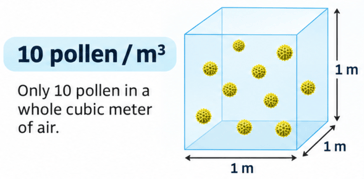
Depending on the pollen type and individual sensitivity, some highly sensitised individuals may experience allergic symptoms at concentrations as low as approximately 10 pollen grains per cubic metre of air.
To put this concentration into perspective:
- 1 pollen grain in 100 litres of air
- 10 pollen grains in a volume of 1 × 1 × 1 metre
These examples illustrate how few pollen grains may already be relevant to allergy sufferers.
 |
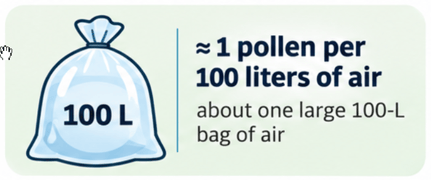 |
Figure 2: Visualisation of the very low pollen concentrations that may already be relevant to allergy sufferers.
Why is measuring such low concentrations difficult?
At low concentrations, only a small number of pollen grains may be detected within a given measurement interval.
For example, at 10 pollen/m³, an instrument analysing an effective air volume of 100 litres would encounter an average of only one pollen grain, assuming a constant concentration and ideal collection and detection.
When only a few particles are counted, statistical counting uncertainty becomes significant.
To provide reliable concentrations at hourly resolution, a pollen monitoring system therefore needs to:
- Sample and effectively analyse a sufficiently large volume of air.
- Detect and count pollen particles with high efficiency.
- Distinguish target pollen from interfering airborne particles.
- Quantify uncertainties in the resulting concentration measurements.
The effective analysed air volume is particularly important for measuring low pollen concentrations with high temporal resolution.
Why does the sampling method matter?
The traditional Hirst method, described in EN 16868:2019, typically provides daily average pollen concentrations after manual microscopic analysis. Although shorter measurement intervals are technically possible, the relatively small effective air volume evaluated during microscopic counting can lead to substantial statistical uncertainty at low concentrations.
In addition, manual evaluation generally introduces a delay between sampling and data availability.
Automatic instruments such as SwisensPoleno address these limitations through continuous particle measurement and automated classification.
SwisensPoleno instruments incorporate an aerosol concentrator that increases the number of relevant airborne particles directed towards the measurement system. Combined with an appropriate sampling volume and validated measurement performance, this supports reliable pollen concentration measurements at hourly resolution.
The important question is therefore not simply how much air an instrument samples, but how much air is effectively analysed and with what measurement uncertainty.
3. Reliable Classification and Accurate Pollen Concentrations
Detecting airborne particles is only the first step. A pollen monitoring instrument must also determine which detected particles belong to relevant pollen types.
This is the task of the classifier.
AI-based classification uses the information collected from individual particles to assign them to defined classes, including allergenic pollen taxa.
Reliable classification requires two complementary capabilities:
- High sensitivity: Correctly identifying pollen grains belonging to a target class.
- High specificity: Avoiding the incorrect classification of other airborne particles as the target pollen type.
The second requirement is particularly important because pollen grains are measured in a complex atmospheric environment containing many other biological and non-biological particles.
Incorrect identification can lead to false pollen concentration peaks, while missed pollen grains can result in underestimation.
From classified particles to pollen concentrations
The resulting pollen concentrations are calculated using the number of identified pollen grains, the effective analysed air volume and, where necessary, appropriate corrections for measurement performance.
The output is a concentration time series for the relevant pollen types, typically expressed as pollen grains per cubic metre of air.
For timely allergy information, hourly concentration data are particularly valuable because daily averages may conceal short-duration pollen peaks.
However, a high temporal resolution is useful only when the resulting concentration measurements are sufficiently reliable.
Why classifier validation is essential
Pollen composition varies significantly between geographical regions and throughout the pollen season.
Different vegetation, climatic conditions, flowering periods and long-distance pollen transport can influence which pollen types occur at a monitoring location.
The composition of interfering airborne particles also changes with location and environmental conditions.
Therefore, classifier performance should be evaluated under real-world conditions, preferably using independent reference datasets covering different monitoring locations, seasons and pollen concentrations.
Such evaluations should answer:
- Which pollen taxa can the classifier reliably identify?
- Where and under which environmental conditions was it validated?
- Which performance metrics were used?
- How accurately do the resulting concentration time series agree with reference measurements?
- How does the classifier perform at low, allergy-relevant concentrations?
Scientific initiatives such as SYLVA, BioAirMet and EUMETNET AutoPollen contribute to the development of validation approaches, measurement quality assessment and harmonisation of automatic bioaerosol monitoring.
Ultimately, the quality of the resulting pollen concentrations depends on both the measurement instrument and the classifier.
Further information about the measurement technologies and classification approaches used by Swisens is available in the Swisens Knowledge Base.
4. Continuous Operation, High Availability and Low Maintenance
Reliable pollen monitoring requires more than accurate measurements. Instruments must also operate continuously throughout the pollen season.
Missing measurement data can result in pollen peaks remaining undetected and reduce the reliability of pollen information services.
For operational monitoring networks, high data availability and low maintenance requirements are therefore essential.
Ideally, scheduled service intervals should cover an entire pollen season, typically around six to ten months depending on geographical location and application.
Important operational characteristics include:
- Continuous and fully automated measurement.
- Long-term stability of measurement performance.
- High availability of valid concentration data.
- Minimal onsite maintenance.
- Low or no consumable requirements.
- Remote monitoring, diagnostics and software updates.
- Reliable data transmission and recovery after interruptions.
SwisensPoleno systems are designed to reduce particle accumulation and simplify maintenance. Consumable-free measurement operation, remote monitoring, remote diagnostics, remote support and maintenance training help minimise operating effort and downtime.
Long maintenance intervals and reduced onsite interventions also contribute to lower total monitoring costs, particularly when operating geographically distributed networks.
5. Standardisation and Comparability Across Monitoring Networks
When multiple instruments are operated as part of a monitoring network, measurement comparability becomes essential.
Pollen concentration data from different instruments must be sufficiently consistent to support regional comparisons, shared classification software and reliable information services.
Three aspects are particularly important.
Instrument-to-instrument comparability
Different instruments measuring the same air should provide comparable results within defined measurement uncertainties.
This requires controlled instrument characteristics, appropriate calibration and quality assurance procedures.
Classifier transferability
A classifier developed and validated for a particular instrument type should ideally operate across compatible instruments without extensive instrument-specific adaptation.
This is important for efficient network deployment and maintenance.
Long-term data comparability
Pollen monitoring also contributes to long-term environmental and climate research.
Changes in instruments, measurement technologies or classifier versions can introduce differences in the resulting concentration time series.
Long-term comparability therefore requires documented measurement characteristics, controlled updates and appropriate procedures for assessing differences between historical and newly generated data.
Standardisation is an important foundation for these requirements.
Through international scientific cooperation and participation in standardisation activities, Swisens contributes to improving the quality, comparability and interoperability of automatic pollen monitoring systems.
6. From Pollen Concentrations to Actionable Allergy Risk Information
Pollen concentration measurements are the quantitative foundation of pollen allergy risk information.
However, concentration data alone do not directly describe the individual health impact of airborne pollen.
General pollen load or risk categories, such as low, moderate and high, can be derived by applying pollen-type-specific thresholds or other risk estimation methods.
Actual allergic symptoms depend on several factors, including the pollen type, individual sensitisation, exposure conditions and personal susceptibility.
Reliable, timely concentration data provide an essential basis for pollen risk information, forecasting and personalised allergy information services.
Completing the Pollen Intelligence Value Chain
After particle measurement and classification, the resulting data must be processed, quality-controlled, stored and made available to users.
A complete Pollen Intelligence Value Chain therefore consists of:
- Particle measurement: Detecting and characterising individual airborne particles.
- AI-based classification: Identifying relevant pollen taxa.
- Concentration calculation and quality control: Producing reliable pollen concentration time series.
- Risk estimation: Translating pollen concentrations into meaningful pollen allergy risk information.
- Data provision: Delivering information through databases, APIs, dashboards and other digital interfaces.
- Information use: Supporting weather services, public health authorities, healthcare professionals and allergy sufferers.
For monitoring network operators and information providers, the value lies not only in the instrument itself, but in the quality, reliability and accessibility of the complete data product.
7. Seven Questions to Evaluate an Automatic Pollen Monitoring System
When comparing automatic pollen monitoring technologies, instrument specifications alone are insufficient.
The following seven questions provide a practical framework for evaluating the quality and operational value of a complete measurement and classification system.
-
How rich is the information collected from individual particles?
Which particle characteristics are measured? What information is used by the classifier, and how effectively does it support the differentiation of relevant pollen types from interfering particles? -
Can the system reliably measure low pollen concentrations at hourly resolution?
What is the effective analysed air volume? What measurement uncertainty is achieved at low, allergy-relevant concentrations, for example 10 pollen/m³? -
How accurately are airborne particles detected and counted?
Are particle collection efficiency, counting efficiency, detection limits and measurement uncertainties quantified? Is supporting validation evidence available? -
Are measurements comparable across instruments and networks?
Are measurement methods standardised and instruments appropriately calibrated? Can data from different instruments, locations and monitoring periods be compared reliably? -
How reliable and complete are the measurement data?
What data availability, latency and temporal coverage can be achieved under real operational conditions? How are data gaps and quality issues identified and handled? -
How well has the pollen classifier been validated?
Against which reference datasets, at which locations and during which seasons was the classifier evaluated? Which performance metrics were used, and what were the results? -
How efficiently can the system be operated and integrated?
What maintenance and onsite interventions are required? Are consumables needed? How are the resulting pollen concentrations made available, and which data interfaces are supported?
These questions help distinguish between the ability to detect particles and the ability to deliver reliable, actionable pollen information.
8. Supporting Pollen Monitoring Network Expansion with SwisensPoleno Callisto
Meeting these requirements on a larger geographical scale also calls for monitoring solutions that combine validated measurement technology with low operational complexity and affordable network deployment.
SwisensPoleno Callisto has been developed with these objectives in mind.
Building on the established measurement principle of SwisensPoleno Mars, Callisto combines digital holography with AI-based pollen classification to provide real-time pollen information.
Compact, lightweight and plug-and-play
Designed for straightforward installation and easier deployment, supporting the expansion of pollen monitoring networks.
Lower total cost of monitoring
The compact system design aims to reduce equipment, installation, maintenance and service costs, making automatic pollen monitoring more accessible.
Easy maintenance and remote support
The concentrator core can be exchanged using guided maintenance instructions. Remote diagnostics and support help reduce onsite operating effort.
Established measurement technology and European classification
Callisto builds on Swisens' experience in automatic pollen monitoring and scientific collaboration.
It is designed to support established European pollen classification applications, with classifier development for additional geographical regions available by agreement.
9. Real-World Example: The SwissPollen Network
An operational example of automatic pollen monitoring is the Swiss national pollen monitoring network operated by the Swiss Federal Office of Meteorology and Climatology, MeteoSwiss.
Since January 2023, Switzerland has operated an automatic national pollen monitoring network using SwisensPoleno instruments.
The network provides hourly pollen concentration data for important allergenic pollen types, including birch, oak and grasses.
Previously, pollen observations were primarily based on manual analysis, with daily concentrations becoming available after a delay.
The introduction of automatic monitoring enables near-real-time information on changing pollen concentrations throughout the day.
These observations support improved pollen information services and provide valuable input for forecasting applications.
For allergy sufferers and healthcare professionals, more timely pollen information can support better-informed decisions about exposure management and preventive measures.
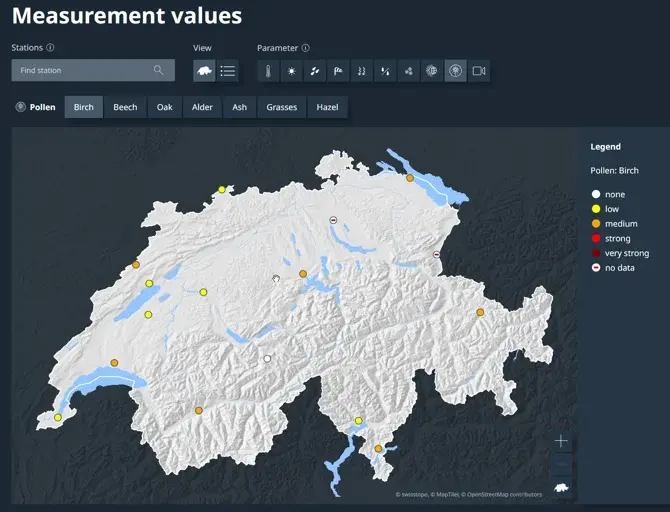
Figure 3: Example of hourly pollen concentration data provided by the MeteoSwiss automatic pollen monitoring network.
MeteoSwiss also provides information about long-term pollen season developments through its pollen season and climate monitoring services.
Conclusion: The Value Lies in the Quality of the Information
Automatic pollen monitoring is much more than detecting airborne particles.
Reliable pollen information requires the combination of information-rich particle measurements, validated classification software, accurate concentration calculations, standardised methods and continuous operation.
This becomes particularly important when measuring the very low pollen concentrations that may already be relevant to allergy sufferers.
Equally important are high data availability, comparability across monitoring networks and reliable interfaces for delivering information to users.
The value of an automatic pollen monitoring system is therefore determined not simply by the number of particles it detects, but by the accuracy, reliability, comparability and usefulness of the pollen information it delivers.
Swisens addresses these requirements through its integrated approach to particle measurement, AI-based classification, data processing and information delivery — supporting the development and expansion of reliable automatic pollen monitoring networks.
Explore the Swisens Knowledge Base to learn more about automatic pollen monitoring technologies, measurement quality and pollen classification.